Showing posts with label King Lear. Show all posts

Monday, November 7, 2016

King Lear as an Allegory, Not a Tragedy

After conferencing with Dr. Burton, I intended to expand on my King Lear essay for my final research paper. In that paper, my thesis statement read as follows: "Despite being disguised in a pagan setting, King Lear should be read as an attempt to replicate the Book of Job in the Bible, as evidenced by numerous parallels in plot, theme, and speech." It worked well, but I had a rather dissatisfying conclusion. My last paper ended with this observation: "Understanding King Lear is based on the Book of Job is important because it shows the undeniable influence of the Bible on Shakespeare’s plays, further cementing the Bible as an invaluable work in literary history." It is very well-documented that the Bible did play a huge role in Shakespeare's works, so my statement is rather unimaginative. 
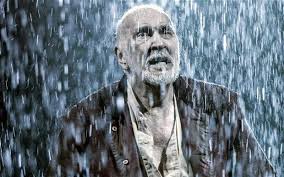
Image result for king lear

Dr. Burton helped me realize that, just like a thesis statement, the suggested literary implications that result from one's claim also need to not be obvious and (maybe?) divide an educated audience. Dr. Burton proposed that a possible implication from my claim is that King Lear should be read as an allegory rather than as a tragedy. This is a very interesting argument because King Lear is one of Shakespeare's most well-known tragedies. I would definitely be arguing against what is generally accepted, making it a good paper topic. So my new thesis statement will end up being something like this: "Although King Lear is traditionally read as a tragedy, it should be read as an allegory because of its similarities with the Book of Job." (I'll keep working on it.)

Some of my research so far:

  • This excerpt from a book has potential as it discusses whether or not King Lear should be read as a Christian allegory or a different kind of allegory.
  • This article from a Catholic website is interesting because it talks about how King Lear is an allegory based on Lear and Cordelia's reconciliation and how it is similar to New Testament doctrine. Maybe it would shape my thesis into including proof from both the Old and New Testaments. 
  • This article by Ian Johnston could be helpful as it has a section devoted to discussing the play as a Christian allegory. However, it seems to be more philosophical than biblical. 
  • I was super happy to find this article by John S. Tanner, current president of BYU-Hawaii. He doesn't expound too much on Lear as his paper is on Job, but it was neat to see he also made the connection. 
  • Garret Fisher suggested on Slack that I could explore the idea of Job maybe not being a factual account and just an allegory. His suggestion could potentially add a very dynamic element to my paper. 
  • Hahahaha from climate change to good vs. evil to daddy issues, this twitter search revealed that people view King Lear as a tragedy for just about everything. Maybe something useful there?

I think there is a lot of potential. I am excited to get going on it.


Continue Reading...

Thursday, October 13, 2016

Sam's "King Lear" Prewriting

King Lear's final speech is absolutely heartbreaking.
He's trying so hard to keep his grasp on Cordelia's life
that he doesn't realize that his own is slipping out of his reach. 
The feedback that I received from Professor Burton advised me to develop a stronger claim in my analysis and to do more close analyses on the form of the play. I've been attempting to analyze not only the form of this play but the major themes that reoccur throughout the play, especially the themes of nature and nihilism. Most of that which I have annotated and highlighted on my Ebook has to do with these two themes, especially in regards to Edmund and King Lear. 

The comments on Slack by my peers have really enabled me to develop my ideas about "King Lear". One comment that especially stands out was shared by Micah Cozzens about Edmund's death, and how it was "but a trifle" and this has a lot to do with the nature theme throughout the play. I've loved the different images that people have shared, especially the charts that people have shared that map the story of the play- these have helped me stay focused while reading the play and keep up with the plot. 

For a few of these claims, the idea that helped me was thinking about listening to this play without seeing it acted or having a text to read- basically, how this play could be formatted to radio. 

[policy claim] It should be recognized that while each character in "King Lear" expresses individualism through their diction, their individuality is also seen in the form in which they speak and development of character throughout the play becomes apparent as form changes, as well. 

[definition claim] "King Lear' is not a play that celebrates or decries the use of natural elements in determining fate, rather, nature is simply acknowledged and heeded to in the development and demise of characters. 

[comparison claim] The study of madness and foolery in "King Lear" is consistent with this theme in "Hamlet", but these similar tragedies should not be studied comparatively but contrastingly because the far-reaching effects of madness vary subtly between the two productions. 

[evaluation claim] While some scholars claim that the theme of nihilism is one of existentialism, it is better to see this theme as one of substance rather than nothingness, because the nihilism that Lear attempts to claim is actually anything but nothing. 

[causal claim] The madness that King Lear experiences is unmistakable as a result of the form in which he speaks, compared to the form that Edgar's speech takes as he attempts to fake madness as a disguise. 

Continue Reading...

Kate's Pre-Writing

This passage is a perfect example of nihilism that is present throughout the text.

During my time studying King Lear, I focused on Nihilism, which is apparent as I look back on all my previous notations. Having it all out in front of me has been a good help for analyzing the information. And the purpose of the nihilism, I believe, is aiding in the bleakness of the story.

On Slack, we had a couple people bring up Nihilism, and information on it. A quick google search also gave me some different sources, from Shmoop (http://www.shmoop.com/king-lear/nothingness-symbol.html) all the way to a powerpoint presentation on the topic. We also had someone bring up the Stranger, which reminded me that they really are similar in this idea of nihilism. These different sources will help me to have a well-rounded analysis.

Working Claims:
|
[Definition Claim] Nihilism in King Lear is a representation of the nothingness that occurs at the end of King Lear's life.

[Policy claim]King Lear should be read as a nihilistic tale.

[Evaluation Claim] King Lear is a better story because of its' use of nihilism and the tone that this brings to the entire text.

[Casual Claim] King Lear's feeling of nothingness was caused by his loss of former power and title.

[Comparison Claim]King Lear and it's idea of nihilism is like  The Stranger by Albert Camus.


Continue Reading...

Isaac's Lear Pre-Writing: I'm Going On An Adventure!

This illustrates how I annotated this ebook.
Form is marked in blue. Themes/content
is marked in yellow. These are some themes
that I have looked into for my paper.
My Analyzing and Annotating
Reading summaries before the text has helped to focus more on how the play is written rather than trying to figure out what is going on at the same time. I was able to use different colors to point out analysis of form, content, and just things that I liked (as shown on right). That will be helpful moving forward because it will allow me to easily find literary support for a strong claim, something that I felt was lacking from my sonnet analysis. I was even able to put in some notes connecting to sources that I and other people found and posted on slack.

Peer and Source Influences
The slack conversations have been enlightening. Through conversations, my own analyses have been questioned, tempered, or validated through others' opinions or through research. I was able to find and interact with good sources, such as this scholarly article dealing with Edmund's Redemption, found and posted by Brett, or this video portraying an extremely supportive Fool, both of which opened a new perspective on characters and themes.

My Working Claims

[Policy Claim] Although many have read King Lear as a critique and handbook on political policy, the play should actually be read as a critique and handbook on filial relationships, not only through Lear's relationships but also (and especially) through the Gloucester family.

[Definition Claim] Although it may seem that Cordelia is a righteous daughter, in actuality, she is just as selfish as Goneril or Regan, disrespecting her father and inheriting a fortune larger than that of her sisters.

[Comparison Claim] While both Kent and Edgar disguise themselves as different characters, Kent's disguise functions as a more selfless and helpful mechanism for the King, while Edgar's disguise is ultimately selfish and futile.

[Evaluation Claim] Although many characters try to help King Lear during his descent into madness, the Fool is the best support system to keep the King sane because of his [the Fool's] own insanity and selflessness.

[Causal Claim] Although some would argue that Edmund's evil intentions arise solely from society's stigmatization of illegitimate children, Edmund's real psychological struggle arises from his own negative conceptions of himself in relation to his father, Gloucester.
Continue Reading...

Wednesday, October 12, 2016

Mary's King Lear Pre-Writing


This quote of Lear's to Gloucester and Edgar 
seemed to bring the themes of foolishness 
together and was something I though a lot 
about while comparing character parallels.
I also noted that the lines are in fine meter, 
despite Lear's madness.
Analyzing an Annotating

In analyses, I usually look mainly at theme and characters because these lenses help allow me to engage with the entire work more easily.  This time, though, I tried to look a little more at elements of meter and use of language and tried to make annotation of this in my e-book that were focused and organized.  I also tried to keep a narrower view as I searched for ideas to write about because my split thesis was the main issue of my last analysis. 

Influences

Seeing other's thoughts as they read through the play really helped me in my character analysis to see how others interpreted the characters and the connections that they drew between them.  The different sources opened me up to a wide variety of experiences with fresh insight into the play. Connecting things in the play to outside social media and national events made it more relevant and offered new perspectives.

Working Claims

[causal claim] Even though madness and blindness separate Lear and Gloucester from the other characters, these states lead the two to better understand the world around them because it let's them experience a different side of the world that contrasts with their original ideas.

[comparison claim] Although the fool is often compared to Cordelia, his role is more like that Edgar’s in the way each, under a guise of foolishness, serves as a sort of guide to a disabled and troubled master.

[policy claim]  Despite Lear’s speech disregarding fidelity, the reader should determine that lust is actually condemned in the play as a folly since it causes the downfall of many characters.

[definition claim] Although age is often cited as a primary factor of  the way Lear and Gloucester misunderstand the world, wealth in the play is also an element associated with their detachment and blindness, as it keeps them from having to experience the hardness of reality. 


[evaluation claim]  Despite the vagueness of the connection in the actual script, it is better to read King Leer knowing that Cordelia and the fool were often the same actor in order to fully understand the role that each plays in the king's fall and redemption.
Continue Reading...

King Lear--Literary Analysis and Annotation

An annotated example of a reference to the theme of foolishness
Technology and Shakespeare
Utilizing technology in my reading of Shakespeare texts has been an interesting new experience for me. I enjoy the ability that I have to take Shakespeare and his characters with me where ever I go. To me, this demonstrates the mobility that Shakespeare has, not just literally, but also in the way that his themes and characters are applicable to life across decades and even centuries. This thematic reading has contributed to some of the most interesting conversations that I've had with my peers on Slack.

Peer Discussion
The Slack forum that we have for communicating about our readings has allowed my views to be challenged. For example, with our reading of King Leer, it was proposed as an idea that the fool and Cordelia could be played by the same actor. They supported this idea with research they had done, providing both formal and informal sources. I hadn't even thought about this idea before someone else brought this up. That's why I love this method of discussing between class periods because it allows us to be exposed to different ideas before we arrive at class each week.

As a class, we have generally been doing better at doing rhetorical analysis and focusing on the language of plays. Hopefully, this will continue, although personally the thematic analysis is always what I find most interesting and that stands out to me most.

Thesis Building
As I've been doing the reading and contributing to these conversations, I'm always aware of how I can improve my writing of literary analysis. One of the things that I struggle with is creating powerful and clear thesis for my writing. Strong thesis statements, even in less formal situations, allow us to provide our readers with a clear idea of the idea that we are analyzing and providing details to support. Here a few examples of thesis statements that could be used in an analysis of King Lear:

[Policy Claim]- Although King Lear is a play about a king and his court, it should be read as a story about familial relationships because of its central connection with both Lear and his daughters as well as Gloucester and his sons.

[Definition Claim]- Despite the fact that Shakespeare's plays can be interpreted in many different ways, King Lear is a tragedy as demonstrated by the decline of Lear due to his tragic flaw.

[Comparison Claim]- While many insist that Cordelia and the Fool are two separate characters, Cordelia and the fool play a similar role as an advisor of Lear and therefore could be played by the same actor.

[Evaluation Claim]- Even though the play centers around King Lear and his daughters, the fact that Edgar is a better son to Gloucester than Edmund drives much of the plot and develops the theme of filial loyalty.

[Causal Claim]- Although Goneril and Regan's betrayal brings devastation to the kingdom, Lear's pride and hubris lead to the real tragedy at the end of the play.
Continue Reading...

Blogroll

About